

Most bloggers stall at four posts a month because writing is slow, not because ideas run out. Add up hosting, plugins, and a freelance writer, and a single article can cost more than a month of software. That gap is exactly where autoblogging tools compete, and pricing is the deciding factor.
This guide breaks down Autoblogging.ai's plans, from the $19 Starter tier to the $999 top option, plus annual savings up to 37 percent. You will see what credits, rollover, and human proofreading actually cover, and which plan fits your blog, site, or agency.
What Is Autoblogging.ai? WordPress Autopilot Explained
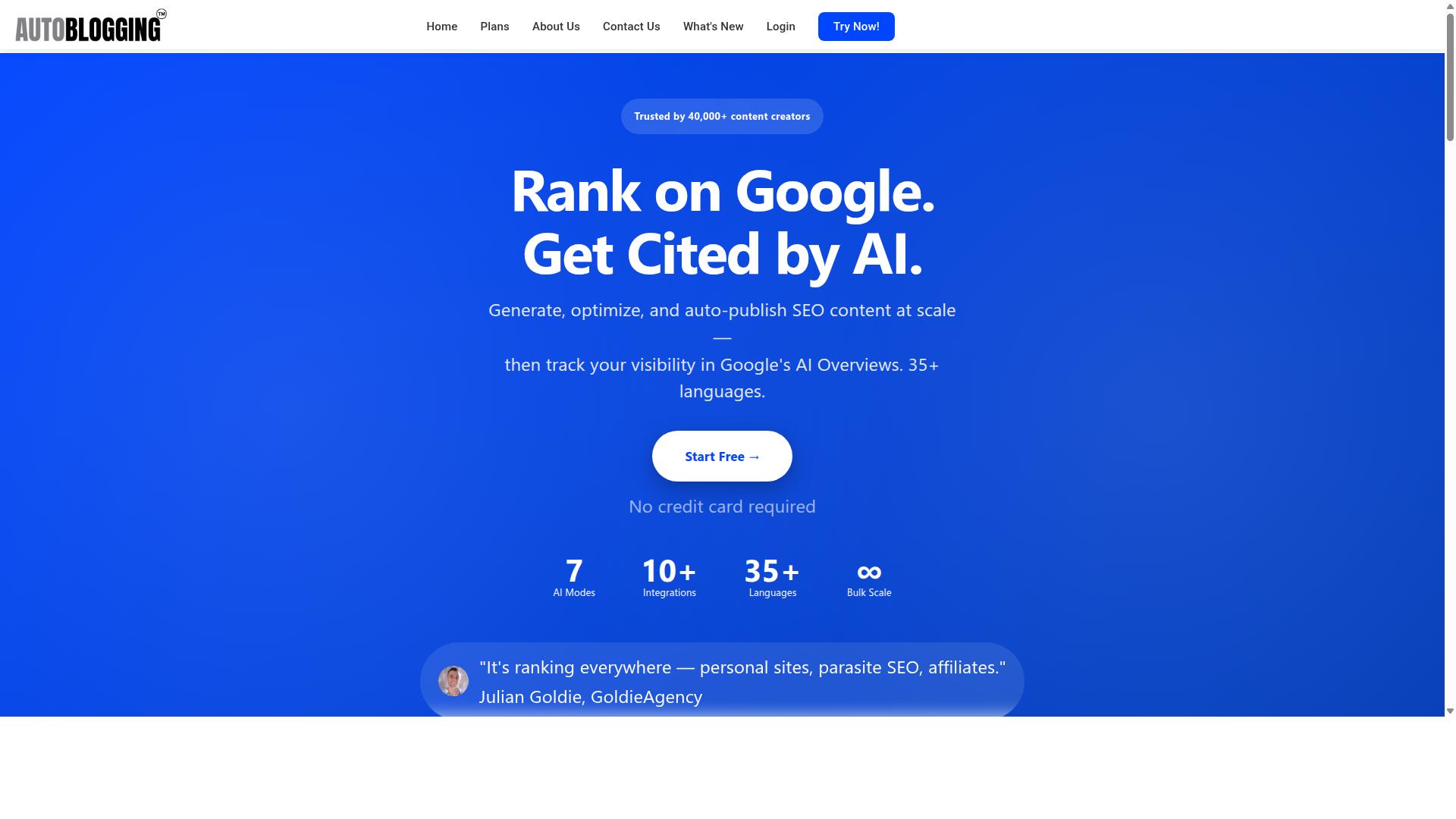
Autoblogging.ai is an AI-powered content automation platform that turns a single keyword into fully formatted, SEO-optimized WordPress articles and publishes them on a schedule you control. It is a product of Digimetriq.com, built to help bloggers, website owners, and agencies save time and improve their online presence through cutting-edge technology.
In practice, WordPress autopilot means you supply the direction and the software handles the production line. You provide seed keywords or an RSS feed, the platform generates articles, and it pushes them to your WordPress site as drafts, scheduled posts, or live posts. The result is content automation that keeps publishing even when you are not at your desk.
The workflow follows three straightforward steps. Each one replaces a manual task that would otherwise eat into your week.
- Connect your WordPress site. A one-time setup links the platform to your site so it can deliver finished articles straight into your publishing queue.
- Enter keywords or a feed. You choose the topics you want covered, either as seed keywords or through RSS feed integration, and the system takes it from there.
- Set a publishing schedule. Decide whether new articles arrive as drafts, scheduled posts, or live posts, and how often they should appear.
That third step is where scheduled posts and drip content become practical. Instead of a burst of publishing followed by silence, your site can receive a steady flow of articles over time. For bloggers juggling multiple sites or agencies managing client blogs, that consistency matters more than any single burst of output.
One important clarification: Autoblogging.ai is not an article spinner or a paraphrasing tool. Those older tools reshuffle existing text and produce awkward, duplicated content. This platform uses large language models for original generation, drawing on natural language generation to write fresh articles rather than rewriting someone else's.
Because it is a SaaS product, there is nothing to install on your server and no local setup to maintain. You access it through your browser, which keeps the technical overhead low and makes it workable for non-developers. The mission behind it is to cut down content costs and enable human counterparts in their standard operating procedures with a solid first draft.
Think of this section as orientation only. The details of what you pay, which plans exist, and how credits or tokens are counted belong to the pricing discussion later in this guide. What matters here is the shape of the tool: connect, supply topics, schedule, and let automated content generation handle the repetitive work of keeping a WordPress site stocked with SEO content.
How Much Does Autoblogging.ai Cost? Full Pricing Breakdown
Autoblogging.ai uses a credit-based subscription model with monthly plans from $19 to $999, and annual billing that can save you up to 37% depending on the tier. Credits are the currency of the platform: one credit typically equals one article generation, though advanced modes may consume more per run.
Every plan is available as a monthly subscription or an annual plan, and new accounts get 10 free credits per month with no credit card required, a genuine freemium model that lets you test automated content generation before paying anything. Unused credits roll over, so nothing is lost at the end of a billing cycle.
Below, the monthly tiers are broken down credit by credit, followed by how annual billing changes the effective rate. Payments are accepted via Visa, MasterCard, American Express, and PayPal, with bank transfers available for annual enterprise plans through Stripe, and you can cancel anytime.
Monthly Plans: $19 to $999 (Credits and What Each Tier Unlocks)
The monthly lineup starts at $19 for 40 credits and scales to $999 for 5,000 credits, with each tier adding more generation capacity and access to advanced AI modes.
| Plan | Monthly Price | Credits |
|---|---|---|
| Starter | $19 | 40 |
| Regular | $49 | 120 |
| Standard | $99 | 300 |
| Gold | $179 | 600 |
| Premium | $249 | 1,000 |
| Enterprise | $999 | 5,000 |
Credits are spent per article generated, and Godlike Mode may consume more than one credit per run because it layers in SERP competitor analysis, LSI keywords, and knowledge graph extraction. Higher tiers unlock that mode along with Bulk Generation for up to 500 articles at a time, which matters for agencies running content automation at scale.
A useful benchmark: a blogger publishing one article per day needs roughly 30 credits a month, so Starter covers light use comfortably. Bulk publishers and agencies should look at Gold or above to avoid running dry mid-month.
Credits roll over, so unused balance does not expire at month-end. Additional credits can also be purchased separately if you need a top-up without changing tiers.
Annual Plans: Save Up to 37% With Yearly Billing
Switching to annual billing reduces the effective monthly cost by up to 37%, with the exact discount varying by tier. You pay once per year instead of twelve times, and the lower effective rate is the main trade-off for committing upfront.
The math is straightforward. If the Regular plan runs $49 per month, an annual plan at roughly 37% off works out to about $31 per month, or around $370 per year. The published annual rates follow the same logic across the range, from Starter at $12 per month ($148 per year) up to Enterprise at $649 per month ($7,792 per year).
Annual billing suits users who have already validated their content workflow and are confident they will use the credits consistently across twelve months. If your publishing schedule is still experimental, a monthly plan keeps things flexible since you can cancel anytime.
The rollover benefit applies to annual subscribers too, so you are never forced to burn credits within a single month. Credits purchased on a yearly plan simply carry forward, which smooths out uneven publishing months and makes the annual plan a reasonable fit for steady content automation rather than a gamble on constant output.
What You Get for the Price: Credits, Rollover, and Human Proofreading
Beyond the raw number of credits, the value of an Autoblogging.ai plan comes from how credits are used, the fact that they roll over, and the human proofreading layer that improves output quality. These three elements separate a credit system that respects your budget from pricing models that quietly drain it.
Most plans on the market look similar on the surface. The difference shows up in the details of how each credit is spent, what happens when you do not spend them, and whether quality control is baked into the monthly fee or sold as an extra.
One credit typically equals one standard article. That is the baseline for automated content generation on the platform. When you generate a standard piece, you spend a single credit. Simple, predictable, and easy to plan around.
Some modes and workflows consume credits differently. Godlike Mode, the platform's highest-quality AI mode, may use more credits per article because it does more work. Bulk generation runs also draw from the same balance, so a large batch spends more at once. This is normal for any AI writing assistant that scales output.
The practical advice here is to budget credits by output type. If you plan a mix of standard posts and Godlike Mode articles, estimate the heavier mode at a higher credit cost and reserve accordingly. That keeps your monthly fee aligned with actual production.
Rollover is where the credit system earns its keep. Unused credits carry over to the next billing cycle. You are not forced to burn credits before a reset date just to avoid losing them.
This matters for anyone running WordPress autopilot on a schedule. Some months you publish heavily, others you slow down. Rollover means a quiet month is not a wasted month. Your balance stays available for the next push.
Compare that with token-based pricing or API usage cost models. Those charge by consumption, often per token or per API call, and unused capacity typically does not carry forward. You pay for what you use, but you also lose what you do not. There is no cushion.
Autoblogging.ai takes a different approach. The subscription behaves more like a bank of production capacity than a meter running on every request. For a plugin subscription tied to steady content automation, that predictability is worth real money.
The human proofreader is included in all plans. Articles can be routed for a human review pass before publishing. That review targets factual errors and awkward phrasing, the two problems that most often undermine AI-generated content.
This is not a separate paid add-on. It is part of the platform's quality assurance, bundled into the same monthly fee. Many tools in this space charge per token or per API call and offer no proofreading layer at all. You get raw output and handle the cleanup yourself.
For anyone publishing SEO content at scale, that cleanup is the hidden cost. A human review pass reduces the risk of shipping errors and cuts the editing hours you would otherwise absorb. The value shows up in output quality, not just in the invoice.
Put together, the plan delivers three things a per-token model rarely does:
- Predictable credit use: one credit for a standard article, with heavier modes costing more
- Rollover: unused credits carry into the next billing cycle instead of expiring
- Human proofreading: included in every plan, not sold as an upgrade
That combination is what makes the pricing structure work for long-term content automation. You are paying for a system that plans around your pace, not one that punishes you for slowing down.
Free and Low-Cost Options: Quick Mode and the Starter Plan
You can start using Autoblogging.ai without paying anything by using Quick Mode, which generates single articles for free, and then upgrade to the $19 Starter plan when you need more volume or advanced features. For anyone weighing the monthly fee of an AI writing assistant, this freemium model removes the risk from the first step. You get to see real output before any money changes hands.
Quick Mode is the free entry point on the platform. It supports single-article generation through a wizard interface, which walks you through the basic inputs needed for one piece of content. It is best suited to two situations: testing the quality of the output, or filling an occasional gap in your publishing schedule. If you post once a month and just need a hand now and then, Quick Mode may be all you ever use.
The Starter plan at $19 per month is the lowest paid tier, and it comes with 40 credits. That volume is enough for a personal blog publishing a few posts per week. A hobby site, a niche affiliate blog, or a small portfolio project can run comfortably at this level without stretching the credit system.
What you do not get on the free tier matters just as much as what you do. Quick Mode does not include Godlike Mode, which performs SERP competitor analysis, LSI keyword work, and knowledge graph extraction. It also does not cover bulk generation, which can produce up to 500 articles via CSV, or scheduled publishing. Those capabilities live in the paid tiers.
Upgrading to Starter unlocks more than extra credits. It opens the door to the wider content automation toolkit, including scheduled auto-posting through the WordPress integration. For a site running on autopilot, that shift from manual generation to scheduled posts is the real dividing line between the free and paid experience.
Here is a practical tip before you commit to any monthly fee. Use Quick Mode first to test the AI's writing style against your specific niche. Generate a sample article on a topic you know well, read it critically, and judge whether the tone and structure fit your site. If the output reads the way you want, the Starter plan becomes a low-risk next step. If it does not, you have lost nothing.
This approach also helps you estimate your real credit needs. Publish a few free articles, track how often you actually need new content, then match that pace to a plan. Choosing a tier based on genuine publishing habits beats guessing at the outset.
Why Autoblogging.ai Is the Best Value for WordPress Autopilot
Autoblogging.ai delivers a combination of direct WordPress publishing, a wide range of AI modes, and bulk generation capacity that is difficult to match at its price point. It is not simply an AI writing assistant that produces text for you to copy elsewhere.
Instead, it functions as a full autopilot system. It connects to WordPress and other publishing platforms, supports dozens of languages, and is built to produce content at scale rather than one article at a time.
That distinction matters in a cost and pricing guide. A cheap tool that still requires hours of manual work per post is not really cheap. A platform that handles generation, optimization, and publishing end to end changes the real cost calculation.
Autoblogging.ai is trusted by 40,000+ content creators, holds a 4.9 average rating, and has generated over 1M articles. Those numbers reflect a platform built for ongoing use, not occasional experiments. The two sections below explain the concrete features behind that value.
One-Click WordPress Publish and 35+ Integrations
The platform connects directly to your WordPress site, allowing you to publish generated articles as drafts, scheduled posts, or live content with a single click. You authenticate your site once, and the tool can then push articles to it without manual copy-pasting.
Categories and tags can be set as part of that flow, and posts can be scheduled for drip content so your site keeps publishing on a steady rhythm. This is what turns automated content generation into genuine WordPress autopilot rather than a text generator with extra steps.
WordPress is not the only destination. Autoblogging.ai supports 35+ integrations, including:
- Zapier and n8n for connecting to existing workflows
- RSS feeds for generating articles from new feed items
- Web 2.0 platforms such as Medium, Dev.to, Hashnode, Telegraph, and Tumblr
- Multi-platform publishing to Shopify, Wix, Webflow, Blogger, and Ghost
- API access for custom setups
The RSS feed integration is worth highlighting. You can point the tool at a feed, and it will automatically generate and publish articles based on new items that appear there. For news-driven or niche sites, that removes the need to monitor sources by hand.
Unlimited WordPress sites are supported, so the same workflow can cover a single blog or a portfolio. The practical result is fewer manual steps per article and more time spent on strategy, which is where the real savings show up.
10+ AI Modes, 35+ Languages, and Bulk Generation Up to 500 Articles
Autoblogging.ai offers more than 10 distinct AI modes, supports over 35 languages, and can generate up to 500 articles in a single bulk run. Each mode targets a different job, so you are not forcing one setting to handle every task.
Quick Mode is free and comes in single and wizard versions, which suits testing the platform before committing to a paid tier. Godlike Mode goes further, using SERP competitor analysis, LSI keywords, and knowledge graph extraction to shape higher-quality, SEO-optimized content.
Other modes cover specific needs, including News Mode with Google News integration and Amazon Reviews Mode. Optimization tools like the Site Optimizer, Semantic SEO Analysis with its 21-point audit, and the Snippet Optimizer support the content after generation.
Language coverage matters for cost efficiency. With 35+ languages, one subscription can serve multiple regional sites instead of requiring separate tools per market.
The bulk workflow is straightforward. You upload a list of keywords, choose the mode and language, and the system generates up to 500 articles that can be exported or published directly. That scale is what makes the platform suitable for agencies and affiliate marketers managing many sites or large content calendars at once.
Every plan also includes a human proofreader, and credits roll over rather than expiring. For anyone weighing a monthly fee against output, that combination of scale, quality modes, and retained value is the core of the argument.
Trust Signals: 40,000+ Users, 4.9 Rating, and 1M+ Articles Generated
Autoblogging.ai is trusted by over 40,000 content creators, holds a 4.9 average rating, and has generated more than 1 million articles. Those three numbers tell a story that matters when you are weighing a monthly fee or an annual plan against your content budget.
Each signal answers a different question a buyer should ask before committing to any AI autoblogging platform. Together they form a picture of a tool that is stable, well-reviewed, and proven in real publishing workflows.
A 40,000+ user base indicates the platform is established and actively maintained. Software with that many subscribers has survived long enough to earn repeat business, and it generates the feedback loop that drives continuous improvement.
For anyone comparing a plugin subscription to a one-off purchase, scale matters. A large community means the product is not a side project that disappears in six months, taking your published content workflow with it.
The 4.9 average rating reflects satisfaction across review platforms. A score that high, sustained across a user base this size, is difficult to fake and suggests most buyers feel they get fair value from their plan.
Ratings also hint at what happens after purchase. Users who feel overcharged on a monthly fee or misled by a lifetime license rarely leave near-perfect scores, so the number acts as a proxy for real-world experience.
More than 1 million articles generated proves the technology works at scale. That volume of automated content generation would be impossible if output quality or reliability collapsed under load, which matters for anyone planning bulk publishing or scheduled posts.
Named professionals back these numbers with their own reputations:
- Julian Goldie of GoldieAgency, whose YouTube channel has 250k+ subscribers
- James Dooley of FatRank and PromoSEO
- Bart Magera of MojoLinks
- Kyle Duncan, SEO Professional
- Dimitar Georgiev, CEO of IDEAMAX.EU
- Cagri Sarigoz, Founder of Cagri Sarigoz LLC
- Jacky Chou of Indexsy
These are people who make a living from search traffic and affiliate marketing. Their endorsement carries weight because their own results depend on the tools they recommend.
Taken together, the user count, rating, and article total give a buyer a simple way to judge risk. You are not testing an unknown product with your content budget. You are joining a platform with a documented track record and a verified pool of satisfied users.
Who Should Use Autoblogging.ai (and Which Plan Fits)
Autoblogging.ai is designed for bloggers, website owners, SEO professionals, marketing agencies, content creators, and affiliate marketers who need to produce content at scale without sacrificing quality. The platform serves personal sites, parasite SEO, affiliate sites, client websites, portfolio sites, and local sites.
Because the audience is so varied, the plan you choose should match your monthly article volume and whether you need advanced modes like Godlike Mode. The right fit usually comes down to two questions: how many posts you publish each month, and whether you are writing for yourself or for clients.
Here is a practical mapping of audience segments to recommended plans.
- Personal bloggers publishing a few posts per week: Starter ($19) or Regular ($49)
- SEO professionals managing multiple sites: Standard ($99) or Gold ($179)
- Marketing agencies and affiliate marketers running bulk campaigns: Premium ($249) or Enterprise ($999)
Personal bloggers who post a handful of times per week rarely need the highest tiers. The Starter ($19) or Regular ($49) plans cover steady publishing schedules without paying for capacity that goes unused.
SEO professionals juggling several sites need more headroom. The Standard ($99) and Gold ($179) plans suit that workload, especially when keyword optimization and scheduled posts matter across a portfolio.
Agencies and affiliate marketers running bulk campaigns should look at Premium ($249) or Enterprise ($999). Bulk generation lets agencies fulfill client work efficiently, and affiliate marketers can push content across many sites at once.
The deciding factor is monthly article volume, followed by whether advanced modes like Godlike Mode are needed. Match the plan to output, not to ambition, and the pricing stays predictable.
Final Verdict: Is Autoblogging.ai Worth the Cost?
For most users who need consistent, SEO-friendly content, Autoblogging.ai is worth the cost because it replaces hours of manual writing and publishing with a few minutes of setup. The platform combines a free tier with a low entry price of around $19, which means you can validate the output before committing real budget.
That low-risk entry point matters in a market where many AI writing tools push buyers straight into a monthly fee or an annual plan with no trial. Autoblogging.ai instead lets you test the workflow first, then scale spending only when the results justify it.
Several structural features reinforce the value case:
- Credit rollover, so unused capacity is not simply lost at the end of a billing cycle.
- Human proofreading, which adds an editorial layer on top of automated content generation.
- Direct WordPress publishing, removing the copy-paste step between tool and site.
- Bulk generation, which suits agencies and publishers managing multiple sites or high post volumes.
For an individual blogger, that mix turns a tedious content calendar into a manageable routine. For an agency, bulk generation and direct publishing translate into fewer billable hours spent on formatting and uploads.
There are honest limits worth acknowledging. If you only need one article per month, Quick Mode may be sufficient, and a paid plan could be unnecessary spending. And if your niche demands highly specialized or technical content, human oversight is still recommended regardless of which tier you choose.
The practical recommendation is straightforward: start with Quick Mode to test output quality against your niche, then upgrade to Starter or Regular once you are publishing consistently. That path keeps early costs near zero while leaving room to scale.
Questions about plans, credits, or the credit system can be directed to the team by email at [email protected] or by phone and WhatsApp at +91 84605-06553, available 7:00-19:00 IST.
Frequently Asked Questions
How much does Autoblogging.ai cost?
Autoblogging.ai offers monthly plans starting at $19 for the Starter plan (40 credits) and scaling up to $999 for the Enterprise plan (5,000 credits), with options like Regular ($49), Standard ($99), Gold ($179), and Premium ($249) in between. Annual plans are also available and are billed yearly, which typically works out cheaper than paying month to month. Credits roll over, so you don't lose unused capacity at the end of a billing cycle.
What exactly is a "credit" and how many articles does it get me?
Credits are the unit Autoblogging.ai uses to meter article generation, and each plan includes a set number of them per billing period. Because different AI modes consume credits differently, the number of articles you can produce depends on which mode you use. If you want a precise estimate for your workflow, it's best to check the current plan details or contact the team directly.
Is there a free option to try before I pay?
Yes. Autoblogging.ai includes Quick Mode, which is free and available in both single and wizard formats, so you can generate content and test the platform before committing to a paid plan. Once you see how the output fits your site, you can upgrade to a higher-credit plan or move into more advanced modes.
Which plan is right for my blog or agency?
It depends on your publishing volume and how many sites you manage. Solo bloggers and smaller sites usually fit comfortably on the lower-tier plans, while agencies and portfolio or client-site operators generating content at scale tend to need the higher-credit tiers. Since credits roll over, you can start smaller and scale up as your output grows without wasting what you've already paid for.
Does Autoblogging.ai work with my WordPress site?
Autoblogging.ai is built for bloggers, website owners, SEO professionals, and agencies, and it supports 35+ integrations to fit into existing publishing workflows. It's a SaaS platform available worldwide online, so there's nothing to install on your own servers. For the specific integration that matches your setup, check the integrations list or reach out to support.
What kind of support and content quality can I expect?
Autoblogging.ai is trusted by 40,000+ content creators with a 4.9 average rating and over 1 million articles generated, and it includes a human proofreader as part of the service. Support is available 24/7, and new features ship weekly. The platform also offers 10+ AI modes and support for 35+ languages, so you can produce content for a range of audiences and niches.
Recommended Resources: