

You are paying for AI content, but the invoice never tells the full story. Monthly subscriptions, credit limits, and rollover rules quietly decide whether your spend produces articles or just receipts.
By the end of this guide, you will know what Autoblogging.ai charges across every plan and credit tier, how credit-based pricing differs from flat subscriptions, and which plan matches your actual content volume. You will also see why cheap AI content often costs more than it saves, and what a fair price per article actually looks like.
What Is Autoblogging.ai and What Does It Cost?
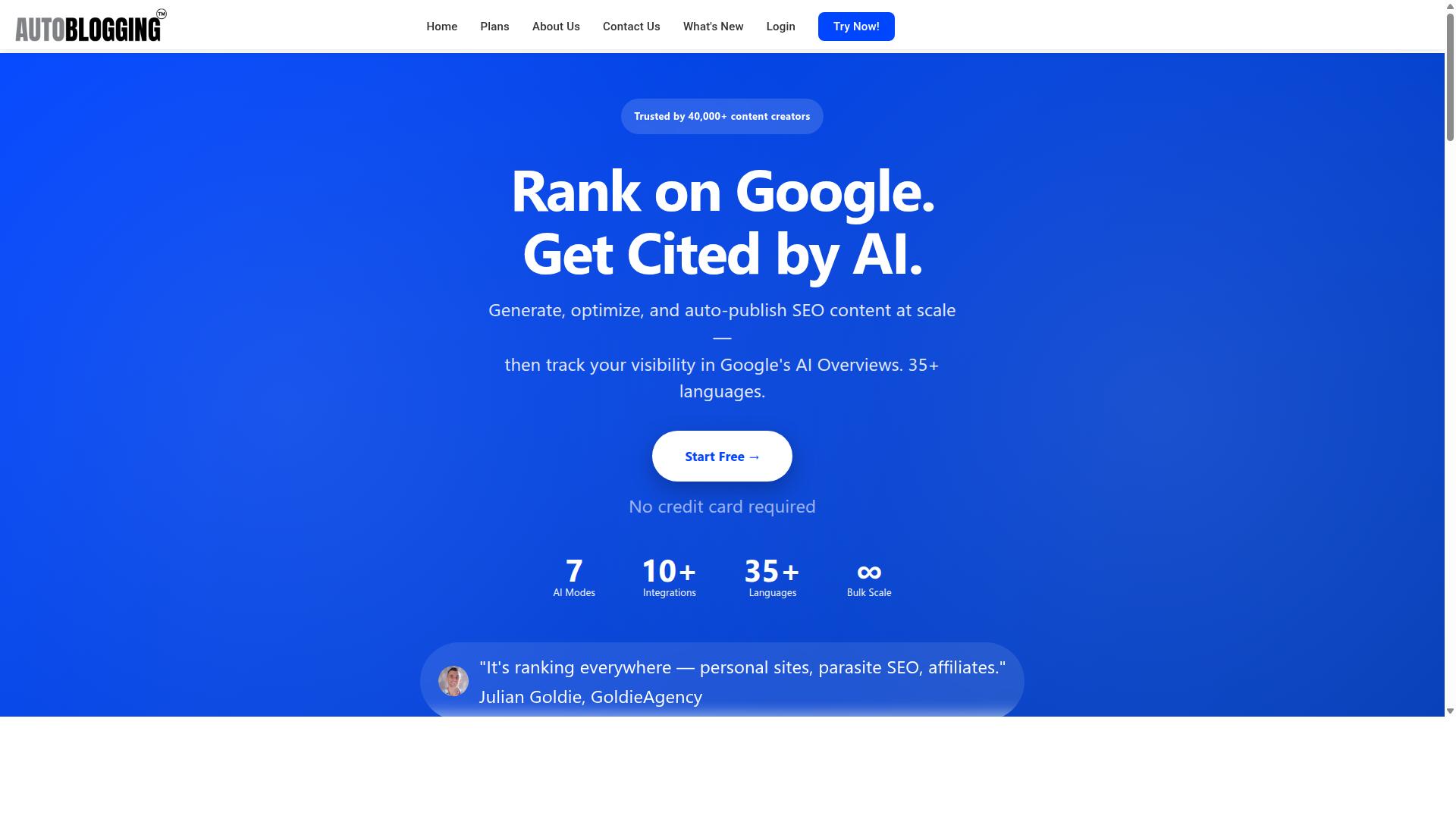
Autoblogging.ai is an AI-powered content generation platform that helps bloggers, agencies, and SEO professionals produce articles at scale, with pricing that starts at $19 per month and scales to $999 for enterprise needs. It is a product of Digimetriq.com, built with a clear mission: help bloggers, website owners, and agencies save time and improve their online presence through cutting-edge technology.
That mission shapes how the platform approaches content creation. Autoblogging.ai aims to cut down content costs and enable human counterparts within existing SOPs by delivering the first draft, while Digimetriq's longer-term goal is to replace human counterparts entirely.
Pricing sits on a credit-based model with multiple plans rather than a single flat subscription. That structure matters in the SEO AI market, because credit systems, usage limits, and tiered pricing are where most buyers get surprised after signing up.
This article exists to fix that. Instead of a sales page, it offers a transparent pricing guide for SEO AI tools: what each tier actually includes, how credits translate into output, where hidden fees tend to appear, and how to run a realistic cost-benefit analysis before committing budget.
Later sections break down plan costs, features, and ROI in detail. For now, the goal is simple: understand who the platform is for, where it sits among SEO AI alternatives, and what questions to ask before paying for any tool in this category.
Who Autoblogging.ai Serves and How It Fits the SEO AI Pricing Landscape
Autoblogging.ai is built for bloggers, website owners, SEO professionals, marketing agencies, and affiliate marketers who need to scale content production without sacrificing quality. It also serves content creators managing a wide range of site types.
Those site types include personal sites, parasite SEO, affiliate sites, client websites, portfolio sites, and local sites. Each comes with a different content burden, and that difference is exactly why a single flat price rarely fits everyone.
Consider how the pain points vary across these groups:
- Bloggers and website owners need steady publishing volume to grow organic traffic, but a slow month means a stalled content calendar.
- SEO professionals juggle keyword research, on-page SEO, and content optimization across multiple clients at once.
- Marketing agencies must deliver consistent output for client websites while keeping production costs predictable.
- Affiliate marketers often run many small sites at once, where content cost per page decides whether a niche is viable.
Bulk generation and multi-language support address these needs directly. Bulk generation matters when dozens of drafts are needed at once, and multi-language support opens local SEO and international markets that would otherwise require separate writers.
In the broader landscape, Autoblogging.ai competes with AI writing assistants and AI SEO platforms on three fronts: price, features, and scalability. Some tools bundle rank tracking, site audits, backlink analysis, or SERP monitoring, while others focus purely on drafting. Buyers comparing SEO AI alternatives should weigh freemium models, pay-per-use options, and annual billing discounts against what they will realistically use each month.
The core value proposition stays consistent across every audience segment: cut content costs, produce first drafts faster, and keep output aligned with existing workflows. That is the standard against which any subscription cost, monthly pricing tier, or enterprise plan should be judged.
What Should You Actually Pay for an SEO AI Tool?
When evaluating SEO AI tools, the sticker price is just the beginning. You must consider credits, usage limits, hidden fees, and the true ROI of generated content.
The headline number on a pricing page rarely reflects what you will spend over a year. A tool advertised at a low monthly rate can end up costing far more once overage charges, feature gates, and add-ons are factored in. A cost-benefit analysis should always start with total cost of ownership, not the entry price.
Build your budget around four questions:
- How is usage measured? Per article, per word, per seat, or per credit? Each model rewards different habits.
- What triggers extra charges? Look for overage fees, per-user add-ons, and premium features locked behind higher tiers.
- What does the tool replace? A writer, a VA, a separate keyword research subscription, or hours of manual editing.
- What is your time worth? If a cheap tool adds three hours of cleanup per article, that labor has a price.
Cheap tools can lead to higher editing costs or poor rankings, which means the savings never materialize. Premium tools may offer better long-term value when they reduce manual work and produce content that performs. The right budget allocation depends on how much content you publish and how much of your workflow the tool genuinely absorbs.
Why Cheap AI Content Often Costs More Than It Saves
Low-cost AI content generators may seem like a bargain, but they often produce generic, unoptimized articles that require heavy editing or fail to rank, ultimately costing more in time and lost traffic.
The first hidden cost is editing time. Generic drafts often need structural rewrites, fact checks, and keyword adjustments before they are publishable. If a $20 tool adds four hours of editing per article, the effective hourly rate of that "saving" is poor compared with a tool that produces cleaner drafts.
The second hidden cost is missed opportunity. Tools that skip competitor analysis and keyword research integration tend to write around a topic rather than target it. Articles that miss search intent do not rank, and content that does not rank earns nothing regardless of how little it cost to generate.
The third risk is quality perception. Thin, repetitive content can weaken a site's overall authority, and recovery takes months of publishing better material. A single round of poor output can set a content calendar back further than the subscription savings ever covered.
This is where feature depth matters. Platforms built for search engine optimization invest in capabilities that cheap generators skip, such as SERP competitor analysis, semantic SEO tools, and a 21-point SEO audit. Autoblogging.ai includes these alongside featured snippet optimization and a human proofreader included in all plans, which directly addresses the editing burden that makes budget tools expensive in practice.
How Credit-Based Pricing Works - and Why Rollover Credits Change the Math
Credit-based pricing ties your monthly cost to the number of articles or words you generate, but the ability to roll over unused credits can significantly improve value for occasional high-volume months.
This model differs from the alternatives in important ways. Seat-based pricing charges per user regardless of output, which penalizes small teams that publish heavily. Unlimited plans look simple but often carry fair-use clauses or feature gates that limit what you can actually do. Credit-based pricing aligns cost with production, and pay-per-use structures suit teams with unpredictable schedules.
Credits are typically consumed in one of three ways:
- Per article generated, regardless of length
- Per word produced, which favors shorter pieces
- Per mode or feature used, such as advanced optimization runs
Rollover credits are the detail that changes the math. Without rollover, unused credits expire monthly and you effectively pay for capacity you never used. With rollover, a quiet month banks value for a busy launch period, so seasonal content pushes do not force an upgrade or a second subscription.
Autoblogging.ai applies this principle directly: credits roll over, which means the platform's 10+ AI modes and 35+ languages remain available for spikes without wasted spend. For teams weighing monthly pricing against annual billing, rollover is the feature that makes the lower tier viable year-round. A track record of 1M+ articles generated across 40,000+ content creators shows the model scales from occasional publishing to continuous output.
Autoblogging.ai Pricing Breakdown: Every Plan, Every Credit
Autoblogging.ai offers six monthly plans ranging from $19 for 40 credits to $999 for 5,000 credits, with annual billing options that provide additional savings. Every tier uses the same credit-based pricing model, so you always know exactly what you are paying for.
The full monthly lineup looks like this:
| Plan | Monthly Price | Credits |
|---|---|---|
| Starter | $19 | 40 |
| Regular | $49 | 120 |
| Standard | $99 | 300 |
| Gold | $179 | 600 |
| Premium | $249 | 1,000 |
| Enterprise | $999 | 5,000 |
Annual billing changes the picture. The same six tiers are billed yearly at effective monthly rates of $12, $32, $64, $116, $162, and $649, which works out to $148, $382, $772, $1,396, $1,942, and $7,792 per year respectively.
Two details matter for budget planning. First, credits roll over, so unused capacity in a slow month is not lost. Second, credits work across the different AI modes on the platform, including Quick Mode, Godlike Mode, Bulk Generation, News Mode, and Amazon Reviews Mode. Some modes consume more credits per task than others, so the same balance can stretch further or shorter depending on how you use it.
New accounts also receive 10 free credits per month with no credit card required, which lets you test the platform before committing to a paid tier. Additional credits can be purchased separately if you run short. Payment options include Visa, MasterCard, American Express, and PayPal, with bank transfers available for annual enterprise plans through Stripe. You can cancel anytime.
Monthly vs Annual Plans: What You Save by Paying Yearly
Opting for annual billing with Autoblogging.ai typically saves you around 17% compared to paying monthly, equating to roughly two months free. Here is the exact math for each tier:
| Plan | Monthly Cost (12 mo) | Annual Price | Savings |
|---|---|---|---|
| Starter | $228 | $148 | $80 |
| Regular | $588 | $382 | $206 |
| Standard | $1,188 | $772 | $416 |
| Gold | $2,148 | $1,396 | $752 |
| Premium | $2,988 | $1,942 | $1,046 |
| Enterprise | $11,988 | $7,792 | $4,196 |
The pattern is consistent: the bigger the plan, the bigger the absolute saving, even though the percentage discount stays roughly the same across tiers. On Enterprise, paying yearly keeps more than $4,000 in your budget.
Cash flow is the trade-off. Monthly pricing keeps your subscription cost flexible, which suits freelancers or anyone still testing how much content they actually publish. Annual billing makes sense when your content needs are predictable, for example an established agency with a steady client roster or a publisher running a fixed editorial calendar. If you already know you will generate content every month for the next year, the discount is essentially free money.
One practical middle path: start monthly on a smaller tier, track your real credit consumption for two or three months, then upgrade to annual once the pattern is clear. Because credits roll over, a mid-year switch does not waste what you have already paid for.
Which Plan Matches Your Content Volume? (Starter to Enterprise)
Match your plan to your content volume: Starter (40 credits) suits casual bloggers, while Enterprise (5,000 credits) is built for agencies managing hundreds of client sites. The simplest formula is credits needed = articles per month × average credits per article. Keep in mind that different modes consume credits at different rates, so your average depends on whether you lean on lighter modes or heavier analysis-driven ones.
Here is how the tiers map to typical usage:
- Starter ($19, 40 credits): A solo blogger publishing a handful of posts per week. The 40-credit balance leaves buffer for testing different modes.
- Regular ($49, 120 credits): A consistent publisher or small site owner who needs a steady weekly output without watching the counter.
- Standard ($99, 300 credits): A growing content operation, such as a niche site portfolio or a small marketing team.
- Gold ($179, 600 credits): Multi-site owners and freelancers serving several clients at once.
- Premium ($249, 1,000 credits): Established agencies with active retainers and regular bulk generation needs.
- Enterprise ($999, 5,000 credits): Agencies managing hundreds of client sites, where bulk generation of up to 500 articles via CSV becomes a routine workflow.
Run the formula against your own numbers before choosing. An agency with 50 clients, each needing 20 articles per month, needs 1,000 articles monthly, and that volume points straight to the Enterprise tier. A blogger publishing 10 articles per month needs at least 10 credits, so Starter's 40 credits provide comfortable headroom for revisions and experimentation.
Also factor in the wider platform. Every plan includes access to optimization tools such as Site Optimizer, Semantic SEO Analysis, Snippet Optimizer, Topical Maps, and AI Infographics, plus publishing through WordPress, Web 2.0 platforms, and multi-platform integrations. Because these capabilities come with the subscription rather than as add-ons, the effective value of a higher tier grows with how much of the toolkit you actually use.
If you would rather skip the credit math entirely, Done For You packages are available at $1,200, $1,600, $4,000, and $10,000, each covering 1,000 articles. That route trades hands-on control for a fixed deliverable, which some teams find easier to slot into a client contract.
What's Included at Every Price Point
Every Autoblogging.ai plan includes access to all core features: 10+ AI modes, 35+ languages, and a human proofreader, ensuring consistent quality regardless of tier. This is a meaningful departure from how many SEO AI alternatives structure their pricing.
With most tiered pricing models, the cheaper plans are deliberately stripped down. You get a limited feature set, and the tools you actually need sit behind a higher subscription cost. That approach complicates your cost-benefit analysis because you are not just comparing prices, you are comparing wildly different products at each level.
Autoblogging.ai takes a simpler route. The features themselves are not gated. What changes as you move up is primarily the volume of credits available, not the capabilities unlocked. That distinction matters when you are trying to decide what you should actually pay.
Consider what this means for budget allocation. If the feature set is identical across tiers, your decision comes down to one question: how much content do you need to produce? You are not forced to overpay for a higher tier just to access a specific mode or tool.
- No feature gates: every plan carries the same core toolkit
- Credits rollover: unused credits carry forward rather than expiring
- Human proofreader: included on all plans as a quality assurance step
- 24/7 support: available regardless of which tier you choose
This structure removes a common frustration with freemium models and entry-level plans, where the advertised price looks attractive until you discover the features you need are locked away. With Autoblogging.ai, the entry point and the top end share the same functional foundation.
The human proofreader deserves particular attention. Many AI content generators stop at generation and leave quality control entirely to the user. Having a human review step built into every plan, not sold as an add-on, is a genuine differentiator in the SEO tools market.
10+ AI Modes, 35+ Languages, and a Human Proofreader on All Plans
Autoblogging.ai provides over 10 AI modes, including Quick Mode and Godlike Mode, support for 35+ languages, and a human proofreader on every plan, from Starter to Enterprise. Each mode serves a distinct purpose, so you can match the tool to the task rather than forcing one approach onto every piece of content.
Quick Mode is built for speed. It handles single and wizard-based generation, making it useful when you need a fast draft without a lengthy setup process. For teams producing content optimization at volume, that speed matters.
Godlike Mode sits at the other end of the spectrum. It is designed for depth, and it is the mode you reach for when a topic demands more than a surface-level treatment.
Beyond those two, the platform offers News Mode with Google News integration and Amazon Reviews Mode, among others. This range means the same subscription covers multiple content types and use cases.
The 35+ language support is significant for anyone running local SEO or targeting international audiences. Instead of paying for separate tools per language, one plan covers global content production.
The human proofreader then reviews output to ensure it is publish-ready. This is not an upsell or a premium add-on. It is standard across all tiers, which means even the most affordable plan benefits from the same quality assurance step as the highest one.
For buyers comparing SEO AI alternatives, this consistency simplifies the pricing guide question considerably. You are not weighing feature lists against each other. You are weighing how much content you need.
Godlike Mode, Bulk Generation, and SERP Competitor Analysis
Godlike Mode performs SERP competitor analysis, extracts LSI keywords and knowledge graphs, and generates content built around what is already ranking. Bulk Generation lets you create up to 500 articles at once via CSV. Both features are available on all plans.
This is where the platform's competitor analysis capability becomes a real competitive edge. Rather than guessing which terms and entities matter, Godlike Mode works from the search results themselves. It pulls in LSI keywords and knowledge graph data so the content aligns with what search engines already associate with the topic.
Bulk Generation addresses a different problem: scalability. Uploading a CSV and producing up to 500 articles in a single batch changes the economics of content production. Tasks that would take weeks of manual effort become a single workflow.
Both capabilities connect directly to the ROI question at the heart of this pricing guide. When a tool can analyze SERP data and generate content at scale from the same plan, the value per credit rises. You are not paying separately for research, analysis, and writing.
- SERP competitor analysis: understand what top-ranking pages cover
- LSI keyword extraction: align content with related search terms
- Knowledge graph extraction: capture entity relationships
- Bulk Generation: up to 500 articles per batch via CSV
These features sit alongside the broader toolkit: Semantic SEO Analysis with a 21-point audit, Snippet Optimizer, Topical Maps, and more. All of it is included regardless of tier.
For anyone weighing monthly pricing against annual billing, the calculation becomes clearer. Since features do not change across plans, the tier you choose should reflect output volume, not a hunt for unlocked capabilities. That is a far simpler decision than most AI SEO platforms ask you to make.
Is Autoblogging.ai Worth the Price? Trust Signals and Track Record
With over 40,000 content creators, a 4.9 average rating, and 1 million+ articles generated, Autoblogging.ai has a strong track record that justifies its pricing for serious SEO professionals.
Those numbers matter in a pricing guide because they answer the question every buyer asks before committing to a subscription cost: has this platform proven itself at scale? A tool with a small user base and no output history is a gamble. A platform used by tens of thousands of creators, holding a near-perfect rating, and producing content by the million is a different proposition entirely.
Autoblogging.ai also ships new features weekly, which signals active development rather than a stagnant product coasting on early momentum. For a cost-benefit analysis, that ongoing investment protects the value of your subscription over time.
Beyond raw numbers, the platform layers in trust-building capabilities that reduce the risk of paying for output you cannot use. These include:
- A human proofreader included in all plans
- A 21-point SEO audit
- SERP competitor analysis and semantic SEO tools
- Featured snippet optimization
- One-click WordPress publish
- 24/7 support
- Credits rollover, so unused capacity is not wasted
Each of these addresses a real cost that would otherwise land on your plate: editing time, audit tools, publishing workflow, and support wait times. When you tally the ROI, the subscription is not just the price of an AI writer. It is the price of replacing several line items at once.
Consider the alternative. Hiring writers for high-volume output means recruitment, onboarding, revisions, and per-word rates that scale linearly with every article you publish. Stacking multiple SEO tools for audits, SERP monitoring, and publishing adds separate monthly bills, each with its own login and learning curve.
Autoblogging.ai consolidates that stack. It covers 10+ AI modes, 35+ languages, and 35+ integrations, so teams producing content across markets or languages do not need to bolt on extra services. For agencies and publishers, that consolidation is where the cost-benefit analysis tips decisively.
Scalability is the other half of the value equation. Credit-based usage with rollover means a slow month does not burn your budget, and a heavy month does not force an emergency upgrade. That flexibility is rare among AI SEO platforms, many of which impose rigid usage limits or charge overage fees.
Industry voices like Julian Goldie and James Dooley have highlighted Autoblogging.ai in their coverage of AI content workflows, which gives prospective buyers third-party signals beyond the vendor's own marketing. Combined with the 4.9 rating from a large user base, the external validation supports what the internal metrics suggest.
Is it the cheapest option on the market? No. There are lower-cost AI writing assistants and free tiers elsewhere. But cheap tools that require heavy editing, lack SEO auditing, or cap your output often cost more in time than they save in dollars.
For professionals who need reliable, high-volume content backed by support, audits, and a proven track record, the value proposition is strong. The price buys capacity, consolidation, and confidence, which is exactly what a serious budget allocation for content should deliver.
Who Should Use Autoblogging.ai - and Who Shouldn't
Autoblogging.ai is ideal for bloggers, agencies, and affiliate marketers who need to produce large volumes of SEO-optimized content, but it may be overkill for hobbyists with minimal content needs. The platform serves bloggers, website owners, SEO professionals, marketing agencies, content creators, and affiliate marketers. Its audience spans personal sites, parasite SEO, affiliate sites, client websites, portfolio sites, and local sites.
That breadth tells you something important about budget allocation. When a tool fits personal blogs and agency client work alike, the deciding factor is usually volume, not skill level. The question is whether your output needs justify a recurring subscription cost.
Agencies managing multiple clients sit at the top of the fit list. When you are responsible for content across several client websites, the math changes quickly. Producing articles manually for each property eats into billable hours and slows delivery. A tool built for scale lets an agency serve more properties without proportionally growing its writing team.
Affiliate marketers running niche sites are a natural match too. Affiliate sites live or die on publishing volume and topical coverage. Autoblogging.ai was built with affiliate sites and parasite SEO in mind, so the workflow aligns with how these operators already think about scalability and content velocity.
SEO professionals scaling content round out the core audience. If your search engine optimization strategy depends on steady publishing across client websites, portfolio sites, or local sites, the platform fits the way you already work. The same logic applies to content creators and website owners who treat publishing as an ongoing operation rather than a one-off project.
On the other side of the line, some users should look elsewhere or wait. Consider these profiles:
- Low-volume publishers. If you only need a few articles per month, a recurring subscription rarely makes sense. The cost-benefit analysis tips toward writing them yourself or paying per piece.
- Writers who prefer full manual control. If drafting every sentence yourself is part of your process or your brand, automation adds little value.
- Very tight budgets. When cash flow is the binding constraint, committing to monthly pricing before you have a content pipeline to feed it is premature.
It is worth noting that Autoblogging.ai offers a free Quick Mode, which gives hesitant users a way to test the waters. That said, free access is limited by design. It is a trial of the concept, not a substitute for a real publishing workflow.
The honest test is simple. Count how many articles you genuinely need each month across every site you manage. If that number is high and steady, Autoblogging.ai is built for you. If it is low or occasional, no AI content generator subscription will pay for itself, and that is a budget decision, not a knock on the tool.
Final Verdict: What You Should Actually Pay
For most users, the Regular plan at $49 per month (120 credits) offers the best balance of cost and volume, but your ideal plan depends on your content output and growth plans.
That single sentence captures the core of this pricing guide. Credit-based pricing rewards you for planning ahead, and the right tier is the one that matches your real monthly publishing rhythm, not the one that sounds impressive on a features page.
Before you commit, run a simple cost-benefit analysis. Estimate how many articles you publish each month, then map that number against the credits each tier provides. If your output fluctuates, rollover credits soften the blow of a slow month, so unused volume does not vanish.
For anyone weighing SEO AI alternatives, the same logic applies across the market. Whether a platform uses tiered pricing, pay-per-use, or freemium models, the question is identical: does the subscription cost match the work you actually need done?
Autoblogging.ai sits in the credit-based pricing camp, which keeps budget allocation predictable. You know what you are spending, and you know what you are getting in return.
Three habits separate smart buyers from overspenders:
- Assess your content volume honestly. Count last quarter's output, not your ambitions.
- Use rollover credits strategically. Bank surplus in heavy months to cover lean ones.
- Choose annual billing for savings. Committing yearly usually lowers the effective monthly cost.
Matching plans to scenarios makes the decision easier. A new blogger publishing a handful of posts monthly rarely needs a large credit pool, so the Starter tier is the natural entry point. A solo consultant or small business with steady output tends to land comfortably on Regular.
Agencies and multi-client teams, by contrast, usually need the higher tiers. Volume, turnaround, and multiple workflows all push credit consumption upward, and Gold gives that headroom.
The upgrade path matters as much as the starting point. Beginning on a lower tier and scaling up as your content operation matures is the lowest-risk approach. You learn your true consumption rate before locking into a bigger commitment.
That approach also protects your ROI. Overbuying credits you never use is the most common waste in credit-based pricing, and it is entirely avoidable with a measured start.
One more check before you decide: watch for hidden fees. Confirm what each tier includes, how credits are counted, and whether annual billing changes the terms. Clarity here prevents surprises later.
If you are still unsure which tier fits, Autoblogging.ai invites you to review current pricing directly and speak with the team. Personalized advice beats guesswork, especially when your content volume is hard to predict.
You can reach the company through several channels:
- India office: 501, Trinity Orion, Vesu, Surat - 395007, Gujarat, India
- Phone/WhatsApp: +91 84605-06553 / +91-8460506553
- Email: [email protected]
- Skype: vibes.yb
- Availability: 7:00-19:00 IST
- United Kingdom office: 2nd Flr, SEO Content Suite, 35 Water Ln, Wilmslow, Cheshire SK9 5AR
- UK phone: +44 1625 359056
- Social: Facebook, Twitter, LinkedIn
The verdict is straightforward. Start where your volume lives today, lean on rollover credits to absorb uneven months, and switch to annual billing once you are confident in your numbers. For most readers, that means beginning below your ceiling and upgrading when the work demands it.
Visit Autoblogging.ai to confirm the latest pricing, or contact support for guidance tailored to your specific content goals. A short conversation now can save you from paying for capacity you never use.
Frequently Asked Questions
How much does Autoblogging.ai cost, and what do you get at each tier?
Autoblogging.ai offers monthly plans starting at $19 for 40 credits (Starter) and scaling up through Regular ($49/120 credits), Standard ($99/300 credits), Gold ($179/600 credits), Premium ($249/1,000 credits) and Enterprise ($999/5,000 credits). Annual plans are also available at a discount when billed yearly. Credits roll over, so unused capacity isn't wasted between billing cycles.
Is there a free way to try Autoblogging.ai before paying?
Yes. Quick Mode is free and lets you generate a single article, either directly or through a wizard, so you can evaluate output quality before committing to a paid plan. If you need SERP competitor analysis, LSI keywords or knowledge graph extraction, those capabilities live in Godlike Mode on paid credits. Starting free and upgrading once you've tested the workflow is the most cost-effective path.
How do I decide which plan tier is right for my content volume?
Match your plan to how many articles you actually publish per month, not to the biggest number you might theoretically need. Because credits roll over, a mid-tier plan such as Regular or Standard is a sensible starting point for most bloggers and small agencies, while Bulk Generation (up to 500 articles via CSV) and higher tiers suit agencies producing at scale. You can move up as your output grows rather than overpaying upfront.
What features justify paying more for a higher tier?
Higher tiers mainly buy you more credits, which unlock more generation across 10+ AI modes and 35+ languages. Advanced modes like Godlike Mode (SERP competitor analysis, LSI keywords, knowledge graph extraction) and News Mode consume credits, so heavier use of these is what typically drives the need for a larger plan. A human proofreader is also included in certain plans, adding value beyond raw article volume.
How does Autoblogging.ai pricing compare with other SEO AI tools?
Pricing across SEO AI tools varies widely depending on credit models, features and whether human editing is included, so compare on cost per usable article rather than headline price alone. Autoblogging.ai is transparent about its tiers, from $19 to $999 per month, and includes credit rollover plus 24/7 support. It's trusted by 40,000+ content creators with a 4.9 average rating and 1M+ articles generated, so you can weigh that track record against alternatives.
Are there hidden costs, and what support is included?
There are no invented add-ons to worry about: your plan is defined by its monthly credit allowance, and unused credits roll over. Autoblogging.ai provides 24/7 support and ships new features weekly, and it's available worldwide online. If you're unsure which tier fits, contact the team directly at [email protected] before upgrading.
Recommended Resources: